
Accounting software has stopped being just a place to record transactions. For a growing SME, it’s the system that decides how quickly you can see cash flow, how fast invoices go out, how easily payables and receivables get tracked, and how prepared you are for tax season. A lot of businesses are still running on spreadsheets or on accounting tools that were never built for how finance teams actually work today, and that gap shows up in the form of manual reconciliation, late reporting, and decisions made on outdated numbers.
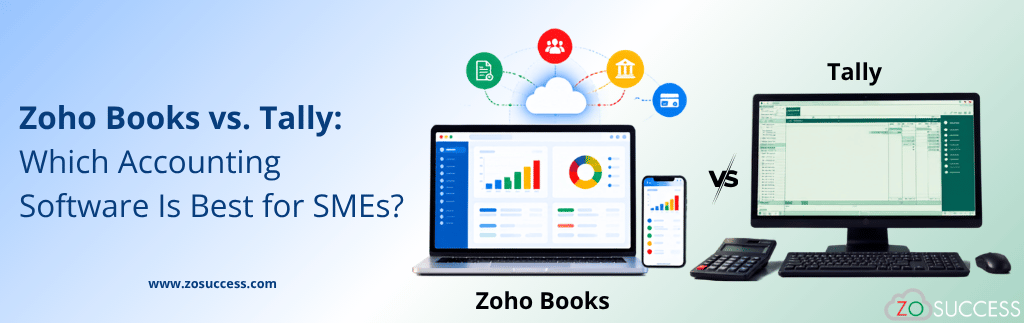
Two names come up constantly when Indian SMEs start shopping for accounting software: Zoho Books and Tally. Both are established, capable platforms, but they come from very different starting points, one cloud-first and connected, the other rooted in traditional, desktop-based accounting. This guide compares them across the criteria that actually matter, so you can figure out which platform fits your finance operations, not just which one has the more familiar name.
What SMEs Should Look for in Accounting Software
Before comparing platforms feature by feature, it helps to agree on what you’re actually evaluating. Most SMEs end up judging accounting software against six areas.
- Core accounting: This is the foundation: general ledger, accounts payable, accounts receivable, bank reconciliation, and the standard set of financial statements. If a platform can’t handle these cleanly, nothing else about it matters.
- Tax and compliance: Every Indian business operates under GST. Look for accurate tax calculation, invoice compliance, e-invoicing where required, e-way bill generation, and reporting that lines up with what the GST authorities expect.
- Automation: Recurring invoices, payment reminders, expense approval workflows, live bank feeds, and automated reconciliation all reduce the manual work finance teams do every month. The more transactions your business processes, the more this matters.
- Business visibility: A finance system should give you more than historical records. Dashboards, cash-flow reporting, profitability analysis, and receivables or payables aging reports turn accounting data into something leadership can actually act on.
- Integration: Accounting rarely lives on its own. It needs to connect with CRM, inventory, payroll, expense management, e-commerce platforms, and banking systems. A platform that stays isolated from the rest of your stack creates duplicate data entry and blind spots.
- Scalability: Can the platform support more users, more locations, multiple currencies, and rising transaction volume without forcing a painful migration eighteen months from now? Scalability is easy to overlook when you’re small and expensive to ignore once you’ve outgrown a platform.
Zoho Books and Tally: An Overview
Zoho Books: Zoho Books is a cloud-based accounting platform built for businesses that want accounting paired with automation and a broader set of connected business applications. Its biggest advantage is how tightly it integrates with the rest of the Zoho ecosystem, which makes it a natural fit for startups, SMEs, professional services firms, trading businesses, and any growing company that wants finance connected to sales, inventory, and operations rather than siloed off on its own.
Tally: Tally is a long-established accounting solution with deep roots in traditional accounting workflows and strong familiarity among accountants and finance professionals across India. It offers solid accounting, taxation, and inventory management capabilities, and remains a common choice for businesses that already run established, accounting-led processes rather than cloud-first, collaborative ones.
Feature-by-Feature Comparison
Choosing the right accounting software depends on more than just basic bookkeeping features. Businesses also need to consider cloud access, compliance, automation, inventory, reporting, integrations, and collaboration.
The table below compares Zoho Books and Tally across these key areas to help you quickly understand their strengths and limitations.
| Feature | Zoho Books | Tally |
|---|---|---|
| Cloud-Based Access | Yes, fully cloud-native | Limited, primarily desktop |
| GST Compliance | Excellent, purpose-built for compliance | Excellent, strong support |
| E-Invoicing (IRN/IRP) | Native, fully integrated | Available with setup |
| E-Way Bill Support | Built-in | Available |
| Automated Bank Reconciliation | Automated with bank feeds | Manual-heavy process |
| Workflow Automation | Advanced, multi-step workflows | Very limited |
| Mobile App | Excellent, full-featured app | Limited mobile support |
| Inventory Management | Built-in, robust | Strong inventory module |
| CRM Integration | Native Zoho CRM integration | Requires custom development |
| Multi-User Collaboration | Strong, role-based access | Limited, primarily single-user |
| Custom Financial Reports | Advanced dashboards, custom reports | Strong accounting reports, basic dashboards |
| Payroll Integration | Native Zoho Payroll | Available as add-on |
| API and Third-Party Integrations | Extensive, via Zoho Marketplace and Zapier | Limited API access |
Zoho Books: Where It Stands Out
- Cloud-based accounting: Zoho Books runs entirely in the cloud; your finance data is accessible from anywhere, on any device. That matters for distributed teams, remote finance staff, and business owners who need to check numbers without being tied to an office desktop or a locally installed application.
- Accounting automation: Zoho Books automates the repetitive parts of bookkeeping: recurring invoices go out on schedule, payment reminders chase overdue receivables automatically, bank feeds pull in transactions directly from your accounts, and reconciliation workflows match records without manual line-by-line checking.
- Real-time financial visibility: Dashboards surface cash flow, receivables, payables, revenue, expenses, and profitability in real time, rather than waiting for a month-end close to find out where the business actually stands.
- Zoho ecosystem integration: This is arguably Zoho Books’ strongest differentiator. It connects natively with Zoho CRM, Zoho Inventory, Zoho Expense, Zoho Projects, Zoho Analytics, and Zoho Payroll, which means sales, operations, and finance data can live in one connected system instead of scattered across disconnected tools. For SMEs already using other Zoho applications, this integration alone can be the deciding factor.
Tally: Strengths and Limitations for SMEs
- Tally’s strength lies in how deeply it’s embedded in traditional Indian accounting practice. It offers strong core accounting, extensive familiarity among finance professionals, solid GST and taxation handling, detailed inventory management, and thorough financial reporting. For businesses with finance teams that already know the platform well, that familiarity reduces training time and operational risk.
- The trade-off is that Tally was built around traditional, accounting-led workflows rather than cloud-first collaboration. Businesses that want broader CRM, marketing, or business automation typically need to bring in additional systems or build integrations to connect Tally with the rest of their operations.
- Tally works well for trading businesses, distributors, manufacturers, and any organization with accounting processes already built around it.
Automation: Which Platform Helps Finance Teams Work Smarter?
Automation is where the two platforms separate from each other in practice, not just on paper.
- Zoho Books: automated payment reminders, recurring transactions, configurable approval workflows, live bank feeds, and automated reconciliation.
- Tally: strong accounting automation within recurring and pre-configured processes, with more emphasis on traditional, structured accounting workflows than on flexible, cross-functional automation.
The real question for any SME is how much manual work your finance team can eliminate. As transaction volume grows, the value of automation compounds. What feels like a minor time-saver at fifty invoices a month becomes a major operational advantage at five hundred.
Tax and Compliance Considerations
Every Indian business operates under GST, and getting compliance right is non-negotiable. When evaluating either platform, look closely at:
- GST-compliant invoicing
- Accurate, automated tax calculations
- E-invoicing support (IRN/IRP generation)
- E-way bill generation
- Tax reporting that matches GST filing requirements
- Audit trails for financial transactions
- How quickly the platform adapts to regulatory changes
Both Zoho Books and Tally have strong GST track records, but they get there differently: Zoho Books builds compliance into a connected cloud platform, while Tally offers compliance support within a more traditional, locally installed environment.
Integrations: Accounting Should Not Operate in Isolation
Modern finance teams rarely work with accounting software alone. It needs to talk to the rest of the business.
- Zoho Books: Connects natively with the broader Zoho ecosystem, including CRM, Inventory, Expense, Payroll, Analytics, and Projects, giving SMEs a genuinely connected operational picture rather than a series of disconnected tools.
- Tally: Supports integrations, APIs, and third-party add-ons, though these often require more setup and configuration depending on the specific business process being connected.
For SMEs already using Zoho CRM or the wider Zoho One suite, Zoho Books tends to offer the more connected, less friction-heavy experience of the two.
Reporting and Business Intelligence
Good accounting software should help leadership answer real business questions, not just produce ledgers. Questions like: How much revenue did we generate this quarter? Which customers owe us money, and for how long? What are our biggest expenses? How much cash do we actually have on hand? Which products or services are most profitable? What will our cash position look like next quarter?
Zoho Books, paired with Zoho Analytics, lets businesses build broader management dashboards that combine accounting data with CRM, sales, inventory, and operational data in one place. Tally delivers detailed accounting and financial reports that remain a strong option for businesses doing traditional financial analysis, though extending that into cross-functional, real-time business intelligence typically requires additional tools.
Ease of Use and User Adoption
The best accounting software is only as good as your team’s willingness and ability to use it. It’s worth comparing the learning curve for accountants, finance managers, business owners, sales teams, and operations staff, not just the finance department.
Key factors to weigh include how intuitive the interface is, how well mobile access supports on-the-go work, how much training staff will need, how granular user permissions are, and how easily different teams can collaborate inside the platform. A powerful system that your team struggles to adopt delivers far less value than a simpler one that gets used consistently.
Scalability: What Happens When Your SME Grows?
Growth changes what you need from accounting software: more users, higher transaction volume, multiple branches or entities, multiple currencies, new product lines, and expanding operations all put pressure on a platform that wasn’t built to scale.
Zoho Books is a strong option for SMEs that expect their finance needs to expand alongside a broader Zoho ecosystem, since new functionality tends to slot into the same connected environment. Tally works well for businesses that plan to grow within established accounting and inventory workflows they’re already comfortable with, though scaling to multi-location, multi-user, cloud-first operations often means layering on additional tools.
Which Accounting Software Should Your SME Choose?
Choose Zoho Books if:
- You want cloud-based accounting with strong automation built in.
- You already use Zoho CRM, Zoho One, or other Zoho applications.
- You want finance connected with inventory, CRM, expenses, and analytics.
- You want a modern platform that can grow alongside your business.
- Your team needs multiple users collaborating from different locations.
Choose Tally if:
- Your accounting team already works extensively within Tally.
- Your business prefers traditional accounting workflows.
- Your tax and accounting processes are already built around it.
Total Cost of Ownership: Look Beyond the Subscription Price
Software cost is only one part of the real investment. A full picture of the total cost of ownership should include license or subscription fees, implementation, data migration, staff training, customization, integrations, ongoing support, maintenance, and any additional applications needed to fill functionality gaps.
A platform with a lower sticker price but a longer, more complex implementation can easily end up costing more over two or three years than one with a higher subscription fee but a faster, cleaner rollout. Total cost of ownership, not the upfront price alone, is the more reliable way for SMEs to compare accounting platforms.
How ZoSuccess Helps SMEs Move to Zoho Books
As a Zoho implementation partner, ZoSuccess works with SMEs to evaluate, implement, and get real value out of Zoho Books, whether that means a fresh setup or a migration away from an existing platform.
Our work typically includes an assessment of your current accounting processes, Zoho Books implementation and configuration, migration from Tally or spreadsheets, data cleansing during migration, GST and compliance configuration, workflow automation setup, integration between Zoho CRM and Zoho Books, inventory integration, Zoho Analytics dashboard setup, finance team training, and post-implementation support.
A successful accounting software rollout isn’t just about installing new software. It’s about aligning that software with how your finance team actually works, so the platform fits the business instead of the business having to bend around the platform.
Final Verdict: Which Is Best for SMEs?
There isn’t a single universally correct answer here. Each platform earns its place with a different type of business.
Zoho Books is best for modern, growing SMEs looking for connected accounting, strong automation, and a broader business ecosystem tying finance to sales, inventory, and analytics. Tally is best for businesses that prioritize established accounting, taxation, and inventory workflows they’re already comfortable running, particularly where a finance team’s existing Tally expertise is a real asset worth preserving.
For SMEs that want to move beyond basic bookkeeping and connect finance, sales, inventory, expenses, and analytics into one system, Zoho Books stands out as the stronger option of the two.
Conclusion: Choosing an Accounting Platform That Grows With Your Business
The right accounting software should support your business today while preparing it for the growth you expect tomorrow. Zoho Books and Tally each bring legitimate strengths to the table, and the right choice ultimately comes down to your business size, GST and compliance requirements, existing technology stack, automation expectations, and growth plans.
For SMEs looking for a connected, cloud-based finance ecosystem rather than a standalone accounting tool, Zoho Books offers a strong combination of accounting depth, automation, integration, and scalability.
Thinking about moving from Tally to Zoho Books? ZoSuccess helps SMEs assess their requirements, migrate financial data, configure Zoho Books for GST and industry needs, integrate it with other Zoho applications, and train finance teams for a smooth, low-disruption transition.
Frequently Asked Questions
Is Zoho Books better than Tally for small businesses?
It depends on what the business values most. Zoho Books tends to be a stronger fit for SMEs that want cloud accounting natively connected to CRM, inventory, and other operations, while Tally is often preferred by businesses whose finance teams already know it well and whose processes are built around its traditional, desktop-first workflow.
Is Tally still relevant for GST compliance compared to Zoho Books?
Tally a choice for GST compliance and is widely used and trusted for this purpose. Zoho Books offers strong GST compliance features, with the added advantage of a modern cloud interface and native integration with other business applications.
Can I migrate from Tally to Zoho Books without losing historical data?
Yes. With proper planning, historical financial data, customer and vendor records, and past transactions can be migrated into Zoho Books. A structured data cleanup and migration process is essential to make sure reporting remains accurate after the switch.
Does Zoho Books support multi-currency accounting?
Yes. Zoho Books supports multi-currency accounting, making it a suitable option for SMEs that invoice international clients or manage vendors and transactions in multiple currencies.
Does Zoho Books integrate with CRM and other business tools?
Yes. Zoho Books integrates with Zoho CRM and other Zoho applications, helping businesses connect accounting, sales, inventory, and customer information in one ecosystem. It also supports integrations with many third-party applications.
Is Zoho Books suitable for growing businesses?
Yes. Zoho Books can support growing SMEs with features such as automation, multi-user access, inventory management, reporting, integrations, and multi-currency accounting. Businesses can also move to higher plans as their requirements increase.
Which platform offers better reporting and automation?
Zoho Books offers strong reporting and workflow automation capabilities, making it a good choice for businesses that want to reduce manual accounting work. Tally is more focused on traditional accounting and financial management, with reporting strength concentrated in core accounting rather than cross-functional business intelligence.
Which platform is easiest for a non-accountant to learn?
Zoho Books is generally considered more approachable for users without a strong accounting background, thanks to its modern, cloud-based interface. Tally is powerful but often has a steeper learning curve for users who are not already familiar with its keyboard-driven workflow.
Ready to Find the Right Accounting Platform for Your Business?
ZoSuccess helps growing SMEs evaluate whether Zoho Books is the right fit and manages the full implementation and migration process, from data cleanup and configuration to training and ongoing support. If you are outgrowing spreadsheets, dealing with a disconnected setup, or simply ready for a more modern accounting platform, our Zoho experts can help you make the move with confidence.Contact ZoSuccess today to start the conversation.


 “ZOSuccess” is the Zoho Consulting Practice of Dhruvsoft Services Private Limited – a leading Zoho Advanced Partner from India – providing services worldwide …