

Sales representatives spend a significant amount of their working day on activities that are necessary for managing a sales pipeline but do not directly contribute to selling. Updating CRM records, searching for customer information, preparing reports, writing follow-up emails, reviewing leads, and keeping opportunity data current can take hours away from customer conversations.
As sales teams grow, this administrative workload becomes even more difficult to manage. Reps may have hundreds of leads to review, dozens of opportunities to follow up on, and numerous customer interactions to record. Without the right tools, important opportunities can be overlooked simply because salespeople do not have enough time to manually analyze every piece of information in the CRM.
This is one of the areas where artificial intelligence is changing the way modern CRM systems work.
Zia, the AI assistant within Zoho CRM, is designed to help sales teams make better use of their CRM data while reducing repetitive administrative work. Instead of expecting sales representatives to manually search through records, reports, and activities for every decision, Zia can provide insights, predictions, recommendations, and productivity capabilities within the CRM environment.
The purpose is not to replace salespeople.
The purpose is to give them an intelligent assistant that can handle some of the repetitive work surrounding the sales process, allowing representatives to spend more time building relationships, having customer conversations, and progressing opportunities.
In this article, we explore how Zia AI can support lead management, opportunity management, sales forecasting, email communication, CRM data quality, natural-language insights, automation, and sales productivity.
Note: Zia capabilities can vary depending on the Zoho CRM edition, configuration, geography, and product updates. Businesses should confirm which capabilities are available in their specific Zoho CRM environment before planning an implementation around a particular AI feature.
Why AI Is Becoming Important for Modern Sales Teams
The traditional sales process often depends heavily on the salesperson. A new lead arrives; the representative researches the prospect, updates the CRM, prepares an email, schedules a follow-up, contacts the prospect again, updates the opportunity, and repeats the process for dozens or hundreds of other leads. None of these activities are necessarily difficult individually. The problem is the cumulative amount of time they consume.
Imagine a sales representative responsible for 500 open leads. Manually reviewing every lead to determine which prospects deserve immediate attention is difficult. The representative may end up working on leads in the order they arrived rather than based on their actual potential. AI-assisted CRM capabilities can change this process.
Instead of treating every lead and opportunity equally, AI can analyze available CRM information and provide signals that help sales teams determine where their attention may be most valuable.
The result can be a more efficient sales process where technology handles more of the information-processing workload while salespeople remain responsible for conversations and decisions. The potential benefits include:
- Less time spent on repetitive CRM administration
- Faster responses to new leads
- Better prioritization of prospects
- More consistent sales follow-ups
- Greater visibility into pipeline activity
- Faster access to customer and opportunity information
- Better use of historical CRM data
The important point is that AI works best as an assistant to the sales team rather than as a replacement for sales judgment.
What Is Zia AI in Zoho CRM?
Zia is Zoho’s AI-powered assistant and is integrated across Zoho applications, including Zoho CRM. Within CRM, Zia is designed to help users work with their customer and sales data through capabilities such as predictions, recommendations, insights, natural-language interactions, and productivity assistance. Depending on your edition, these include features such as Ask Zia, lead and deal predictions, and anomaly detection.
Rather than operating as a completely separate AI application, Zia works alongside the CRM information that sales teams already use. This makes it particularly useful for organizations that have accumulated significant customer, lead, opportunity, activity, and sales-history data inside Zoho CRM.
For example, instead of manually reviewing large numbers of records to identify potential opportunities, sales teams can use available AI capabilities to surface patterns and information that may otherwise require significant manual analysis.
Zia for Lead Management and Lead Scoring
Lead management is one of the most practical areas where AI can support sales teams. Most organizations generate leads from multiple sources, including websites, marketing campaigns, referrals, events, advertisements, and existing customers.
As lead volume increases, manually determining which prospects deserve immediate attention becomes increasingly difficult. Zia can use available CRM information and historical patterns to assist with lead prioritization and conversion prediction.
Depending on the capabilities available in the organization’s Zoho CRM environment, Zia can help sales teams evaluate factors such as:
- Lead information and available data points
- Historical conversion patterns
- Engagement activity
- Email interactions
- Website activity
- Lead source
- Previous sales outcomes
The objective is to help representatives focus their time where it may have the greatest potential value.
Example: Prioritizing 500 Leads
Consider a sales team with 500 open leads. Without AI assistance, representatives may manually sort the list based on lead source, creation date, or their own experience.
With Zia’s insights, the CRM can help identify patterns in the available data that indicate which leads may be more likely to convert. A representative can then use those insights to prioritize outreach. This does not mean that the highest-scoring lead will necessarily become a customer. A prospect’s budget can change, a competitor can enter the deal, or the customer may simply decide not to purchase. AI provides an additional signal for prioritization. The salesperson still makes the final decision.
Zia for Deal and Opportunity Management
AI can also help sales teams understand what is happening across their opportunity pipeline. As the number of deals increases, it becomes difficult for managers and representatives to manually monitor every opportunity.
An opportunity may appear healthy based on its value and stage but still be at risk because there has been no recent activity, the expected close date has repeatedly changed, or important follow-up actions have not occurred. CRM insights from Zia can help identify patterns that deserve attention. Potential use cases include:
- Opportunity outcome predictions
- Opportunity-level insights
- Pipeline analysis
- Identification of potentially stalled deals
- Prioritization of opportunities
- Analysis across sales representatives, regions, or product lines
Identifying Opportunities That May Be at Risk
Consider a high-value opportunity that has not been updated recently. Its expected closing date has moved several times, and the opportunity has gone through multiple stage changes without meaningful customer activity.
Individually, these signals may not seem serious. Together, they may indicate that the opportunity requires attention. Zia can help bring these patterns to the sales team’s attention earlier.
The sales manager can then investigate the situation and decide whether the representative needs to contact the customer, revise the proposal, involve another stakeholder, or change the sales strategy. This is much more useful than discovering that the deal is lost only after the quarter has ended.
AI-Powered Sales Forecasting With Zia
Sales forecasting is another area where AI can provide valuable decision support. Sales leaders need to understand how much revenue is likely to close, which opportunities are at risk, and whether the current pipeline is sufficient to achieve targets.
Traditional forecasting often depends heavily on sales representative judgment. Representatives provide their expectations, managers review the pipeline, and leadership consolidates the numbers. While this approach can work, it can also be subjective. One representative may be overly optimistic about a deal, while another may be overly conservative.
Traditional Sales Forecasting
Traditional forecasting commonly involves:
- Spreadsheet-based calculations
- Manual pipeline reviews
- Sales representative estimates
- Weekly or monthly management meetings
- Historical performance analysis
These methods still have value, particularly because sales representatives have knowledge that may not be recorded in the CRM. However, they can become difficult to scale as the sales organization grows.
AI-Assisted Forecasting
AI can analyze historical CRM information and available opportunity data to provide additional predictive signals. These insights can help sales leaders:
- Identify pipeline risks
- Estimate likely sales outcomes
- Compare forecast expectations with historical performance
- Identify unusual opportunity patterns
- Improve revenue planning
AI forecasts should not be treated as guaranteed predictions. A CRM cannot necessarily know that a prospect’s budget was unexpectedly reduced yesterday or that a competitor offered a major discount this morning. Human judgment remains important. The strongest approach is to combine AI-generated signals with salesperson knowledge and management experience.
Zia for Email Writing and Sales Communication
Email communication represents another significant administrative burden for sales teams. Sales representatives may write dozens of emails every week, including prospecting messages, follow-ups, meeting confirmations, proposal communications, and customer updates.
Although the messages may be different, many follow similar structures. AI assistance can help salespeople accelerate this work. Depending on the capabilities available, Zia can assist with tasks such as:
- Drafting emails
- Rewriting messages
- Adjusting communication tone
- Summarizing information
- Creating personalized communication
- Working with available CRM context
Instead of starting every email from a blank screen, representatives can use existing customer and opportunity information as context and then review and personalize the resulting message.
This can reduce writing time while helping sales teams maintain more consistent communication. The salesperson should still review AI-generated communication before sending it, particularly when the message contains pricing, contractual information, technical details, or sensitive customer information.
Zia for CRM Data Quality and Data Enrichment
AI is only as useful as the data it can work with. This makes CRM data quality an important part of any AI strategy. If customer records contain incorrect information, duplicate contacts, missing fields, outdated information, or inconsistent data, AI-generated insights can also become less reliable. Zia can help identify certain data-quality issues depending on the organization’s configuration and available features. This may include identifying:
- Missing information
- Duplicate records
- Incomplete records
- Inconsistent data
- Potential data-quality problems
The importance of this should not be underestimated. A company can invest heavily in AI, but if its CRM contains poor-quality data, the organization may not get meaningful results. For this reason, CRM data cleansing should come before or alongside AI adoption, not after it.
Natural-Language Insights With Zia
One of the more accessible ways AI can improve CRM usability is through natural-language interaction. Traditional CRM reporting often requires users to navigate dashboards, apply filters, select reports, and understand the underlying CRM structure. For experienced CRM users, this may be straightforward. For business users who simply want an answer to a question, it can be unnecessarily time-consuming.
Where supported by the organization’s Zoho CRM environment, natural-language capabilities can make it easier to access CRM information conversationally. For example, a user may want to know:
- Which deals are expected to close this month?
- Which sales representatives currently have the largest pipeline?
- Which opportunities have not been updated recently?
- Which lead sources are generating the most conversions?
Instead of building a new report for every question, users can use supported natural-language capabilities to interact with CRM information more directly. This can be particularly useful for sales managers and business owners who need quick answers without depending on a CRM administrator for every analysis.
AI and Automation: Turning Insights Into Action
AI and automation are related, but they are not the same. AI is primarily concerned with analyzing information, recognizing patterns, generating insights, or making predictions. Automation is concerned with executing predefined actions based on rules or triggers. For example, AI may identify a lead as potentially high priority. Automation can then assign that lead to the appropriate sales representative and create a follow-up task.
What AI Can Help With
- Identifying patterns in CRM data
- Prioritizing leads and opportunities
- Generating insights
- Predicting possible outcomes
- Supporting sales decisions
- Summarizing available information
What CRM Automation Can Do
- Create follow-up tasks
- Assign leads
- Send notifications
- Trigger approval processes
- Update records
- Execute predefined workflows
When the two are combined, the sales process can become significantly more efficient.
For example:
New Lead → AI-Assisted Qualification → Automated Assignment → Follow-Up Task → Sales Engagement → Opportunity TrackingInstead of requiring a salesperson or administrator to manually initiate every step, the CRM can automate the predictable parts of the process while AI assists with areas requiring analysis.
How Zia Helps Sales Managers
Zia is not only useful for individual sales representatives. Sales managers can use it to gain broader visibility into team performance and pipeline health. Management-level use cases can include:
- Reviewing the overall sales pipeline
- Analyzing regional or team forecasts
- Identifying potentially risky opportunities
- Reviewing lead conversion performance
- Analyzing sales trends
- Understanding representative performance over time
For sales leaders, the value often comes from being able to identify problems earlier. Instead of waiting for a monthly report to show that conversion rates have fallen, management can use available CRM data and Zia’s insights to investigate emerging patterns. This can support more proactive coaching and more productive pipeline reviews.
Zia AI Across Different Sales Scenarios
Although Zia is integrated into Zoho CRM, the practical applications can differ depending on the industry and sales model.
- B2B Sales: B2B sales teams can use AI capabilities to prioritize high-value accounts, identify potentially inactive opportunities, improve follow-up consistency, and analyze longer sales cycles.
- Real Estate: Real estate teams can use CRM insights to prioritize buyer enquiries, identify leads requiring follow-up, and analyze sales activity across properties or projects.
- IT Services: IT service providers often manage long and multi-stage sales cycles. Opportunity analysis can help identify deals that may be slowing down and provide additional signals for forecasting.
- Manufacturing: Manufacturing organizations can use CRM intelligence to prioritize distributor and enterprise opportunities, monitor large deals, and improve pipeline visibility across regions.
- Professional Services: Professional service organizations can use AI and automation to manage proposals, follow-ups, opportunity prioritization, and customer engagement.
The specific implementation should always be based on the organization’s sales process rather than simply enabling every available AI feature.
Zia AI vs. Traditional CRM Workflows
| Sales Activity | Traditional Approach | AI-Assisted Approach |
|---|---|---|
| Lead Prioritization | Manual review | AI-assisted scoring and insights |
| Forecasting | Spreadsheet and representative judgment | Predictive signals combined with CRM data |
| Email Writing | Written manually from scratch | AI-assisted drafting |
| Data Review | Manual identification | AI-assisted identification |
| Opportunity Monitoring | Manual pipeline review | AI-assisted insights and alerts |
| CRM Questions | Reports and dashboard navigation | Natural-language assistance (where supported) |
Common Mistakes When Implementing AI in Zoho CRM
AI adoption can fail when organizations focus more on technology than on the business problem they are trying to solve.
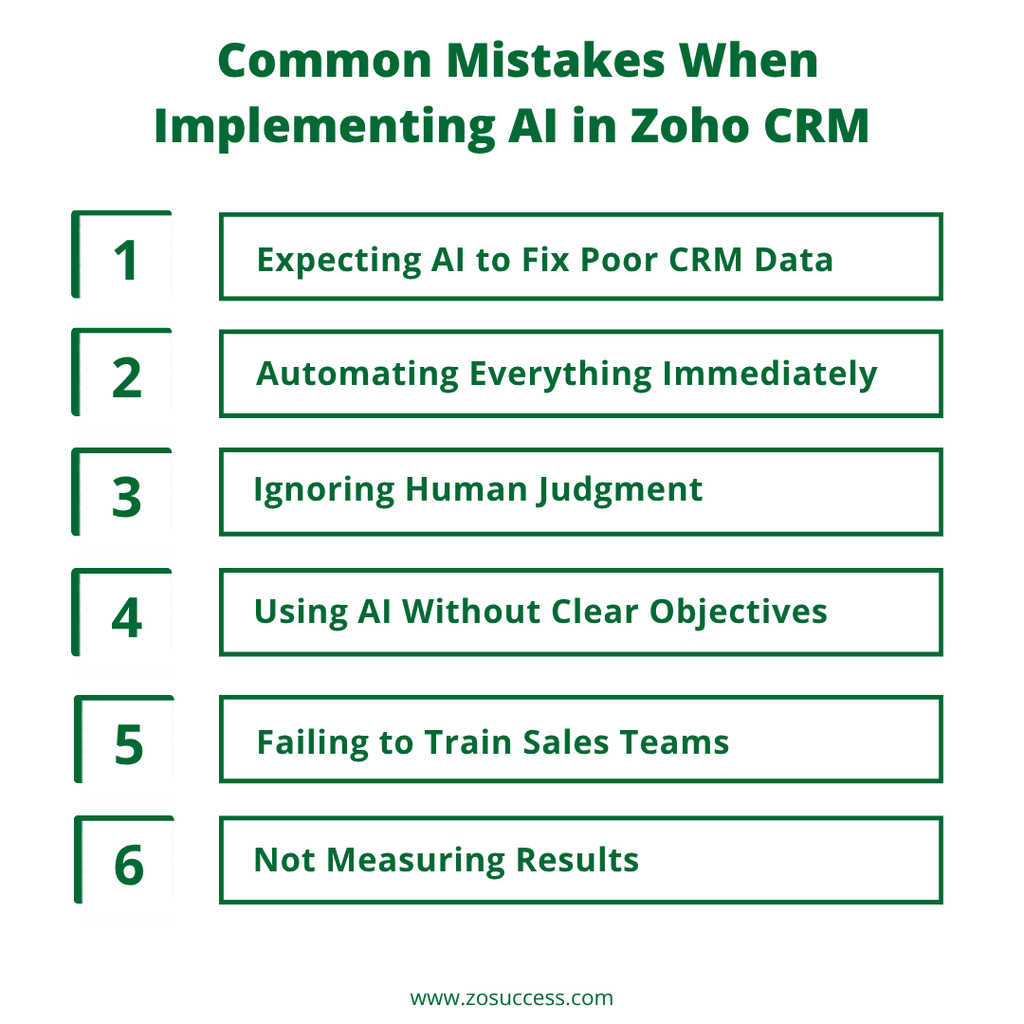
- Expecting AI to Fix Poor CRM Data: AI cannot compensate for fundamentally inaccurate or incomplete customer data. Organizations should establish data-quality standards before expecting AI to deliver reliable insights.
- Automating Everything Immediately: Not every sales decision should be automated. Businesses should begin with repetitive, predictable processes and expand automation as users become comfortable with the technology.
- Ignoring Human Judgment: AI recommendations should support salespeople rather than replace their judgment. Important decisions should continue to receive appropriate human review.
- Using AI Without Clear Objectives: Organizations should define what they want to improve, for example:
- Lead conversion
- Response time
- Sales productivity
- Forecast accuracy
- Opportunity win rate
- Sales cycle length
- Failing to Train Sales Teams: Sales representatives need to understand not only how to use AI features but also their limitations. Good adoption requires users to know when to trust an insight, when to investigate further, and when human judgment should take priority.
- Not Measuring Results: AI initiatives should be reviewed continuously. Organizations should compare AI recommendations and predictions against actual outcomes and adjust their processes accordingly.
Best Practices for Using Zia Effectively
- Start with high-impact use cases by focusing on repetitive, time-consuming sales tasks first
- Maintain clean CRM data so fields and records stay accurate and complete
- Define clear sales KPIs such as lead conversion, win rate, sales cycle length, response time, and forecast accuracy
- Keep humans in the loop and use AI as an assistant rather than an unquestioned decision-maker
- Review AI performance regularly by comparing predictions and recommendations against actual outcomes
- Train users continuously so sales reps understand how to get the most out of AI features as they evolve
How ZoSuccess Helps Businesses Implement Zia and Zoho CRM AI
Implementing AI effectively requires more than switching on available features. ZoSuccess helps businesses evaluate their existing sales processes, configure Zoho CRM, introduce automation, improve CRM data quality, and identify practical opportunities to use Zia AI. Services can include:
- Zoho CRM implementation
- Existing CRM process assessment
- Zia capability configuration
- Sales automation
- Lead scoring configuration
- Workflow and Blueprint implementation
- CRM data cleansing
- CRM data standardization
- Sales dashboards and analytics
- User training
- AI adoption strategy
- Ongoing CRM optimization and support
The implementation approach can follow a structured process:
Assess → Clean Data → Configure CRM → Enable AI → Automate → Train → Measure → Optimize.
The focus should be on measurable business outcomes rather than enabling AI features simply because they are available.
The Future of AI-Powered Sales With Zoho CRM
AI is changing the role of the CRM. Traditional CRM systems primarily focused on storing customer information and helping salespeople track activities.
AI-powered CRM systems are moving toward a more proactive model. Instead of simply recording what happened, the CRM can increasingly help users understand what is happening, what may happen next, and where attention may be required.
For sales teams, this can mean spending less time searching through records and more time acting on useful information. However, successful AI adoption will continue to depend on the following fundamentals: accurate data, well-designed sales processes, clear governance, appropriate automation, and user adoption. AI does not eliminate the need for a good CRM strategy. It makes having one even more important.
Conclusion: Let AI Handle the Busywork While Sales Reps Focus on Selling
Sales representatives should spend their time building relationships, understanding customer requirements, handling objections, developing opportunities, and closing business, not spending most of their day performing repetitive CRM administration.
Zia AI in Zoho CRM can help reduce some of this administrative burden by providing insights, predictions, recommendations, communication assistance, data-quality support, and natural-language interaction where available.
The value, however, does not come simply from enabling AI. The strongest results come when Zia is combined with clean CRM data, clearly defined sales processes, effective automation, measurable KPIs, and appropriate human oversight.
For sales representatives, this can mean better prioritization and less administrative work. For sales managers, it can mean greater visibility into pipeline health and potential risks. For business leaders, it can mean better use of CRM data for commercial decision-making. The goal is not to replace salespeople with AI. The goal is to give salespeople a smarter CRM assistant that handles more of the busywork so they can focus on the conversations and decisions that actually drive revenue.
Frequently Asked Questions
1. What is Zia AI in Zoho CRM?
Zia is Zoho’s AI-powered assistant integrated with Zoho CRM. It helps sales teams analyze CRM data, generate insights, make predictions, improve productivity, and reduce repetitive administrative work.
2. How does Zia AI help sales representatives?
Zia can help sales representatives prioritize leads and opportunities, identify potential risks, assist with email communication, provide CRM insights, and reduce repetitive administrative tasks. This allows sales reps to spend more time on customer conversations and closing deals.
3. Can Zia AI help with lead scoring and prioritization?
Yes. Depending on the Zoho CRM edition and configuration, Zia can use CRM information, historical conversion patterns, engagement activity, email interactions, website activity, and lead sources to support lead prioritization and conversion prediction.
4. Can Zia identify sales opportunities that may be at risk?
Yes. Zia can help identify patterns associated with potentially stalled or risky opportunities, such as limited recent activity, repeated changes to expected close dates, or unusual stage changes. Sales managers can then investigate and take appropriate action.
5. How can Zia AI improve sales forecasting?
Zia can analyze historical CRM information and available opportunity data to provide predictive signals. These insights can help sales leaders identify pipeline risks, estimate potential sales outcomes, compare forecasts with historical performance, and improve revenue planning.
6. Can Zia help sales teams write emails?
Yes. Depending on the capabilities available in the organization’s Zoho CRM environment, Zia can assist with drafting and rewriting emails, adjusting communication tone, summarizing information, and creating personalized communication using available CRM context.
8. Can users interact with Zoho CRM using natural language?
Where supported by the organization’s Zoho CRM environment, Zia’s natural-language capabilities can help users access CRM information conversationally. For example, users may ask about deals expected to close, pipeline performance, inactive opportunities, or lead conversion trends.
9. Does Zia AI replace sales representatives?
No. Zia is designed to support sales representatives rather than replace them. It can reduce repetitive administrative work and provide insights, while salespeople remain responsible for customer relationships, important decisions, and closing opportunities.
10. How can ZoSuccess help businesses implement Zia AI in Zoho CRM?
ZoSuccess helps businesses implement and optimize Zoho CRM by assessing sales processes, configuring Zia capabilities, improving CRM data quality, setting up sales automation, configuring lead scoring, building workflows and dashboards, training users, and developing an AI adoption strategy.
Want to Make Zoho CRM Smarter With AI and Automation?
ZoSuccess helps businesses implement and optimize Zoho CRM, automate sales processes, improve CRM data quality, and identify practical opportunities to use Zia AI for greater sales productivity.
Whether you are looking to improve lead management, automate follow-ups, strengthen sales forecasting, improve CRM adoption, or introduce AI into your sales process, our Zoho CRM specialists can help you build a practical strategy around your business requirements. Talk to ZoSuccess about your Zoho CRM and AI requirements.


 “ZOSuccess” is the Zoho Consulting Practice of Dhruvsoft Services Private Limited – a leading Zoho Advanced Partner from India – providing services worldwide …