
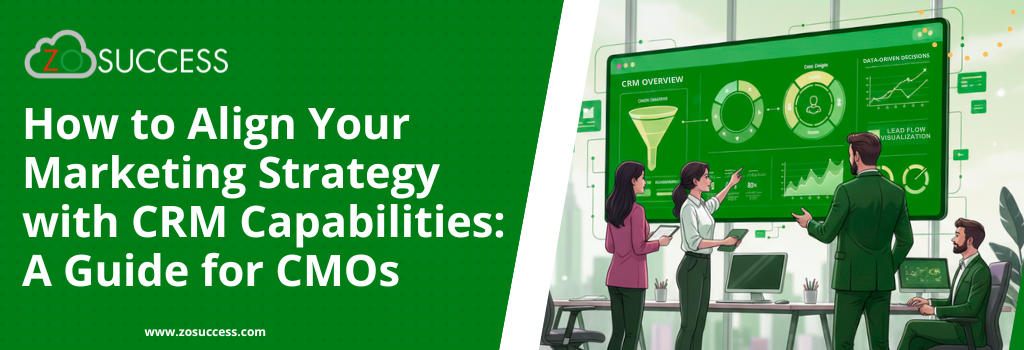
Marketing has changed fundamentally over the last decade. It is no longer limited to launching campaigns, generating brand awareness, or driving website traffic. Modern marketing is data-driven, customer-centric, and directly accountable for revenue outcomes. Today’s Chief Marketing Officers (CMOs) are measured not only on reach or engagement but on pipeline contribution, customer lifetime value, retention, and ROI.
As marketing becomes more measurable, the gap between strategy and execution has become more visible. Many organizations invest heavily in marketing platforms, automation tools, and analytics solutions, yet still struggle to answer critical questions:
- Which campaigns actually drive revenue?
- Which leads convert into customers?
- Where do prospects drop off in the journey?
- How personalized is our engagement across channels?
At the centre of these challenges is a common issue—disconnected marketing systems and under-utilised CRM platforms. When marketing tools operate separately from CRM systems, customer data becomes fragmented, attribution becomes unreliable, and personalization efforts fall short. CMOs lose visibility into the full customer journey, making it difficult to justify budgets or optimize strategy.
This is where CRM alignment becomes a strategic imperative.
A modern CRM, particularly a platform like Zoho CRM, is no longer just a sales database. It is the foundation for customer intelligence, enabling marketing teams to design campaigns, nurture leads, personalise engagement, and measure impact with precision. When marketing strategy is aligned with CRM capabilities, marketing becomes predictable, measurable, and scalable.In this guide, we explore how CMOs can align marketing strategy with CRM capabilities, the role Zoho CRM plays in this alignment, common pitfalls to avoid, and how organizations like ZoSuccess help marketing leaders turn CRM into a true growth engine.
The Modern Marketing Challenge CMOs Face
Today’s CMOs are expected to do much more than run campaigns. They are accountable for pipeline, revenue contribution, customer experience, and ROI. However, most marketing teams are still held back by disconnected systems, poor data visibility, and operational inefficiencies. Let’s look at the key challenges modern marketing leaders face.
Disconnected Marketing Tools and Fragmented Customer Data
Most organizations use multiple tools for email marketing, social media, lead capture, website forms, events, and advertising. When these tools are not connected to CRM, customer data gets scattered across systems. This creates multiple versions of the same customer, incomplete profiles, and inconsistent reporting. CMOs struggle to get a single, reliable view of the customer, which makes planning, targeting, and decision-making much harder.
Limited Visibility into Lead Quality and Campaign ROI
Marketing teams often generate a large number of leads, but not all leads contribute to revenue. Without tight CRM integration, CMOs cannot clearly see:
- Which campaigns generate high-quality leads
- Which sources convert into real opportunities and customers
- Which campaigns are only creating volume but not value
This lack of visibility makes it difficult to optimize budgets and justify marketing spend to leadership.
Poor Alignment Between Marketing and Sales Teams
In many organisations, marketing and sales still work in silos. Marketing focuses on lead volume, while sales focuses on deal closures. Without a shared CRM system and common definitions for MQLs, SQLs, and pipeline stages, this leads to:
- Finger-pointing between teams
- Low trust in lead quality
- Missed revenue opportunities
- Broken hand-offs from marketing to sales
CMOs are under pressure to fix this gap and create a revenue-aligned go-to-market engine.
Inability to Personalize Campaigns at Scale
Modern buyers expect personalized communication based on their industry, behaviour, interests, and stage in the buying journey. But when data is fragmented or outdated, marketing teams are forced to send generic, one-size-fits-all campaigns. This results in:
- Lower engagement rates
- Poor conversion performance
- Weak customer experience
True personalization at scale is impossible without a CRM acting as the central intelligence hub.
Limited Visibility into Customer Journeys and Engagement
Most CMOs still struggle to answer simple but critical marketing questions:
- Which touchpoints influence conversions the most?
- Where do prospects drop off in the funnel?
- Which content and campaigns move deals forward?
When customer journeys are spread across tools, it becomes nearly impossible to track end-to-end engagement. This prevents marketing teams from optimising journeys and improving conversion paths.
Difficulty Proving Marketing’s Impact on Revenue
One of the biggest pressures on CMOs today is proving that marketing directly contributes to revenue. If CRM and marketing systems are not connected:
- Attribution becomes unreliable
- Revenue influence cannot be measured correctly
- Marketing is seen as a cost centre instead of a growth engine
This weakens the CMO’s position in strategic decision-making and budget planning.
Over-Reliance on Spreadsheets and Manual Reporting
Despite using modern tools, many teams still depend on Excel sheets and manual reports to track performance. This leads to:
- Time-consuming reporting cycles
- Human errors and inconsistent numbers
- Delayed insights and slow decisions
In a fast-moving market, this kind of manual dependency kills agility and performance.
Why CRM–Marketing Alignment Matters
In this digital-first business environment, marketing can no longer operate in isolation. To drive real revenue impact, marketing strategy must be deeply connected with CRM. When CRM and marketing work as one system, organizations move from activity-based marketing to revenue-driven marketing.
CRM as the Single Source of Truth for Customer and Lead Data
A CRM system like Zoho CRM becomes the central place where all customer and prospect data lives—from website leads and campaign responses to sales conversations and purchase history. This eliminates data silos and ensures that marketing and sales teams work from the same, trusted data.
With a single source of truth:
- There are no duplicate or conflicting records
- Every team sees the same customer profile
- Data is cleaner, richer, and more reliable
- Campaign targeting becomes more accurate and effective
This foundation is critical for scaling marketing operations and improving overall business performance.
End-to-End Visibility from First Touch to Revenue
When marketing systems are aligned with CRM, CMOs gain complete visibility into the customer journey, from the first website visit or ad click to deal closure and beyond.
This means you can clearly see:
- Which campaigns generate pipeline and revenue
- How leads move through the funnel
- Where prospects drop off or get stuck
- Which touchpoints influence buying decisions the most
This end-to-end visibility transforms marketing from a lead generation function into a revenue growth engine.
Better Lead Quality, Higher Conversion Rates, and Stronger Customer Experience
CRM–marketing alignment allows teams to use behavioural data, firmographic data, and sales feedback to qualify and nurture leads more intelligently. Instead of sending the same message to everyone, marketing can:
- Score and segment leads based on real engagement
- Send relevant content at the right time
- Hand over only sales-ready leads to the sales team
The result is:
- Higher-quality leads
- Better conversion rates across the funnel
- Less friction between marketing and sales
- A more consistent and professional customer experience
Data-Backed Decisions Instead of Gut Feeling
Without CRM alignment, many marketing decisions are based on assumptions, opinions, or partial data. With CRM-driven insights, CMOs can make decisions based on:
- Real conversion data
- Pipeline and revenue impact
- Campaign performance across the full funnel
- Customer behaviour and engagement patterns
This shifts marketing from opinion-driven execution to performance-driven optimization, making it easier to justify budgets, improve ROI, and drive predictable growth.
The CMO’s Role in Aligning Marketing Strategy with CRM
Aligning marketing strategy with CRM is not a technical project; it is a business transformation initiative. The CMO plays a central role in making sure CRM supports real marketing goals, uses the right data, and connects marketing and sales into one revenue engine.
a. Defining Marketing Objectives That CRM Can Support
The first responsibility of the CMO is to clearly define what marketing is accountable for. In modern organizations, marketing objectives typically include:
- Lead generation and demand creation
- Pipeline contribution and revenue influence
- Customer retention and engagement
- Upsell and cross-sell growth
These goals must not remain only in presentations or strategy documents. The CMO must ensure they are translated into CRM-driven execution models.
For example:
- Lead generation goals should map to lead capture, scoring, and nurturing workflows in Zoho CRM
- Pipeline contribution goals should map to campaign attribution and funnel tracking
- Retention and upsell goals should map to customer segmentation, lifecycle campaigns, and account-based marketing processes
When objectives are built into CRM workflows, marketing moves from strategy discussions to operational execution with accountability.
b. Ensuring Data Strategy Comes First
No CRM or marketing automation strategy can succeed without strong data foundations. One of the most important roles of the CMO is to own the marketing data strategy.
This includes:
- Defining what data needs to be captured at each stage of the customer lifecycle
- Standardizing fields, formats, and mandatory data points
- Ensuring consistent lifecycle definitions (Lead, MQL, SQL, Opportunity, Customer, etc.)
- Maintaining data quality, accuracy, and completeness
In Zoho CRM, this means designing:
- Proper lead, contact, account, and deal structures
- Mandatory fields and validation rules
- Clear handover points between marketing and sales
- Clean segmentation-ready data models
The CMO must set the expectation across teams that CRM data is not optional—it is a business asset. Clean and usable data is what enables personalization, accurate reporting, reliable attribution, and confident decision-making.
c. Driving Sales–Marketing Alignment
One of the most critical leadership responsibilities of the CMO is to remove friction between marketing and sales. Misalignment usually starts with different definitions and expectations.
The CMO must ensure there are shared definitions for:
- What is a Lead?
- What qualifies as an MQL (Marketing Qualified Lead)?
- When does a lead become an SQL (Sales Qualified Lead)?
- What counts as a real Opportunity?
Zoho CRM becomes the collaboration layer where this alignment is enforced operationally:
- Marketing and sales work on the same records and pipeline
- Lead handovers are system-driven, not manual
- Feedback loops are built into the process
- Performance is measured using the same dashboards and metrics
When CRM is used this way, marketing and sales stop working as separate teams and start working as one unified revenue organization.
Key CRM Capabilities CMOs Must Leverage
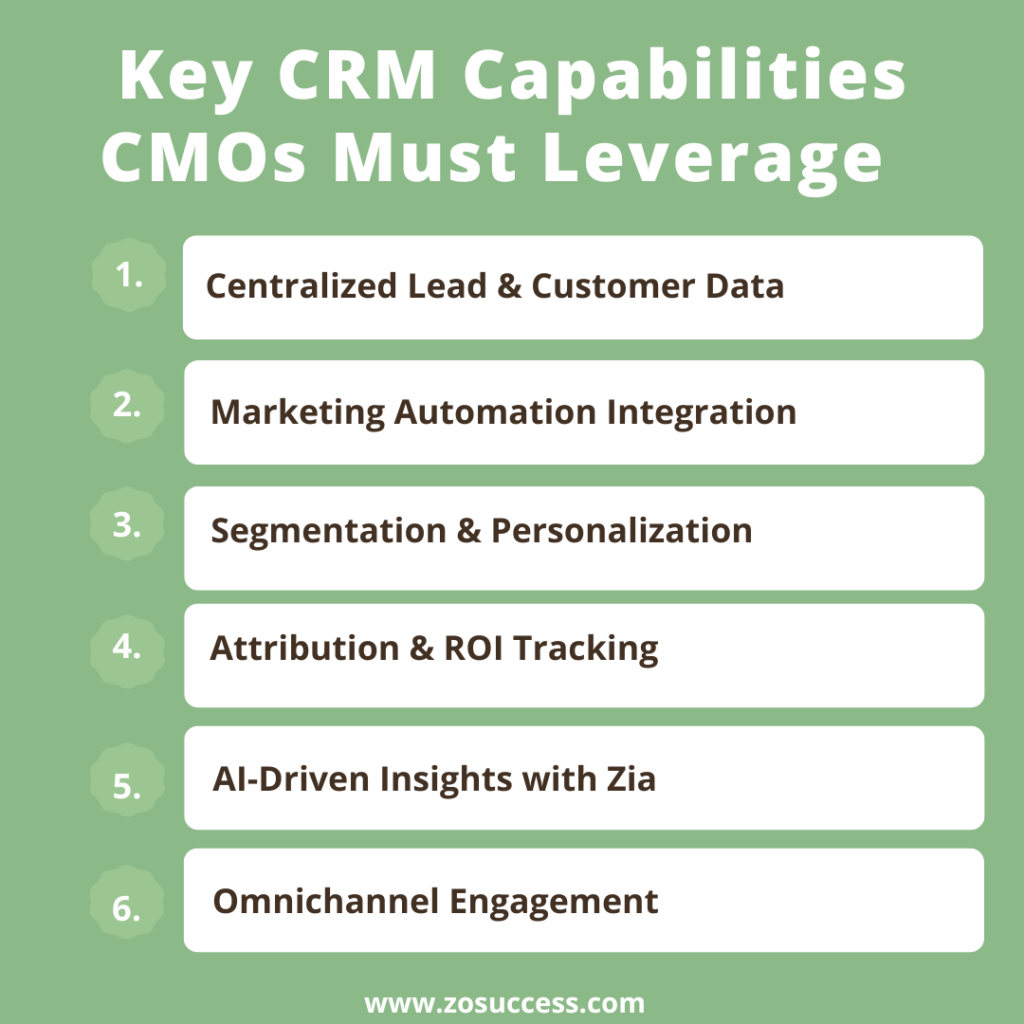
- Centralized Lead & Customer Data : Zoho CRM provides unified customer profiles that capture every interaction—emails, website visits, campaign responses, calls, and meetings. This eliminates data silos and enables marketing teams to understand prospects in context.
- Marketing Automation Integration : Through native integration with Zoho Marketing Automation and Zoho Campaigns, Zoho CRM enables seamless lead capture, nurturing, and scoring. Marketing teams can automate journeys while maintaining visibility into CRM data.
- Segmentation & Personalization : CRM-driven segmentation allows CMOs to target audiences based on behaviour, demographics, and lifecycle stage. Campaigns become more relevant, improving engagement and conversion rates.
- Attribution & ROI Tracking : Zoho CRM enables campaign tracking from lead creation to deal closure, allowing CMOs to measure true marketing contribution to revenue rather than surface-level metrics.
- AI-Driven Insights with Zia : Zoho’s AI assistant, Zia, provides predictive lead scoring, engagement insights, and anomaly detection. These insights help CMOs focus resources on high-impact campaigns and opportunities.
- Omnichannel Engagement : Zoho CRM tracks engagement across email, social media, web forms, chat, events, and more—ensuring consistent messaging and visibility across all channels.
Aligning Marketing Strategy with CRM — Step-by-Step Approach
Step 1: Map the Customer Journey
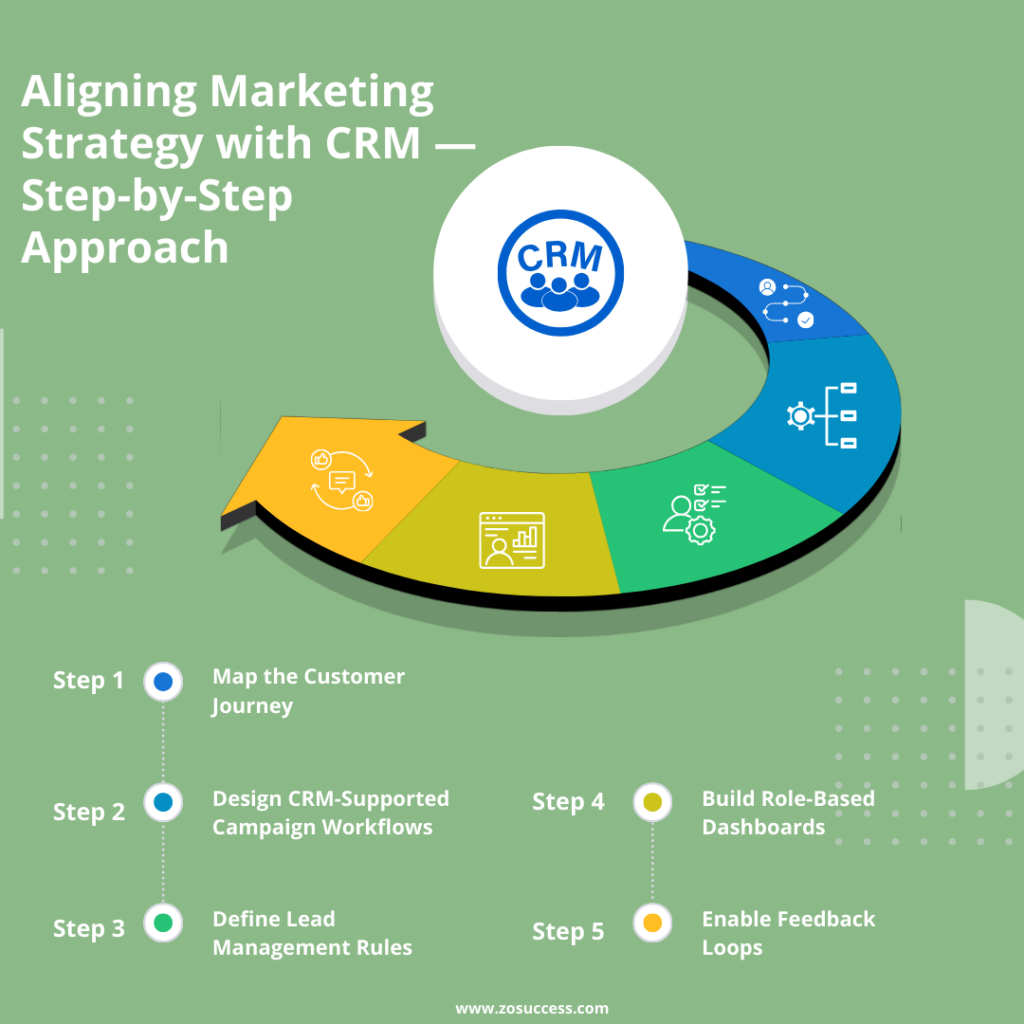
- Identify touchpoints across awareness, consideration, conversion, and retention.
- Align CRM fields, stages, and automation to each phase.
Step 2: Design CRM-Supported Campaign Workflows
- Lead capture → nurture → scoring → handoff to sales.
- Automate workflows using Zoho CRM Blueprints.
Step 3: Define Lead Management Rules
- Clear MQL and SQL criteria.
- Automated assignment and follow-ups.
Step 4: Build Role-Based Dashboards
- CMOs: ROI, pipeline contribution.
- Marketing teams: campaign performance.
- Sales teams: lead readiness.
Step 5: Enable Feedback Loops
- Use CRM reports to refine messaging, channels, and targeting.
Common Mistakes CMOs Should Avoid
- Treating CRM as a Sales-Only Tool : Many companies use CRM only for the sales team. This is a big mistake. CRM should be used by marketing, sales, and service teams. If only sales uses it, customer data stays incomplete and unclear.
- Ignoring Data Quality and Rules : Good CRM needs clean data. If data is wrong or missing, reports will also be wrong. Bad data leads to bad decisions. Data rules and checks are very important.
- Doing Too Much Customization Without a Plan ; Some companies change CRM too much without a clear plan. This makes the system complex and slow. Users get confused. Simple and clear systems always work better.
- Not Training Teams Properly : If users are not trained, they will not use CRM properly. They may avoid the system or enter wrong data. Training helps teams use CRM in the right way every day.
- Tracking Only Vanity Numbers : Many teams look only at clicks and email opens. These numbers look good but do not bring money. CMOs should focus on pipeline, deals, and revenue.
Why Zoho CRM Is Ideal for Marketing-Led Growth
Native Integration with Zoho’s Marketing Tools :
Zoho CRM works smoothly with Zoho Campaigns, Zoho Marketing Automation, and other Zoho tools. Leads, campaign data, and customer details stay in one place. This makes campaign tracking simple and clear.
Cost-Effective Compared to Enterprise CRMs :
Zoho CRM costs much less than many big CRMs. You get strong features without high license costs. This makes it a good choice for small, mid-size, and growing companies.
High Customization with Low Complexity :
You can change Zoho CRM to match your business process. You can add fields, stages, and workflows easily. But the system still stays simple and easy for teams to use.
AI-Powered Insights Through Zia :
Zia is Zoho’s AI assistant. It helps find trends, predict results, and warn about problems. This helps teams take better and faster decisions.
Scalable for Startups to Enterprises :
Zoho CRM works for small teams and also for large companies. You can start small and grow step by step. The system grows with your business.
Strong Analytics and Attribution Capabilities :
Zoho CRM gives clear reports and dashboards. You can see which campaigns create leads, pipeline, and revenue. This helps CMOs prove marketing impact.
How ZoSuccess Helps CMOs Align Marketing & CRM
Marketing Strategy and CRM Alignment Workshops
ZoSuccess starts with workshops to understand your business goals. We study your marketing and sales process. We then design how CRM should support your strategy. This makes sure technology follows business needs.
Zoho CRM + Zoho Marketing Automation Implementation
We implement Zoho CRM and Zoho Marketing Automation the right way. We connect both systems properly. This helps you manage leads, campaigns, and customer data in one place.
Lead Scoring, Attribution, and Automation Design
We design smart lead scoring rules. We set up campaign tracking and revenue attribution. We also build automation to save time and reduce manual work.
Sales–Marketing Alignment Frameworks
We help marketing and sales teams work as one team. We define MQL, SQL, and handover rules. We build clear processes inside Zoho CRM to avoid confusion and delays.
Training, Adoption, and Ongoing Optimization
We train your teams to use the system correctly. We focus on daily usage, not just go-live. After launch, we keep improving the system as your business grows.
Conclusion
Marketing success today depends on how well your strategy works with your technology. If marketing and CRM are not connected, results will always be limited.
When CMOs align marketing goals with CRM, they can run better campaigns. They can personalise customer messages. They can clearly see ROI. They can also create steady and predictable growth.
With Zoho CRM and the right implementation partner, marketing becomes easy to track, easy to improve, and focused on revenue.
Want to align your marketing strategy with Zoho CRM?
ZoSuccess helps CMOs build CRM-driven marketing systems that deliver real business results.


 “ZOSuccess” is the Zoho Consulting Practice of Dhruvsoft Services Private Limited – a leading Zoho Advanced Partner from India – providing services worldwide …